
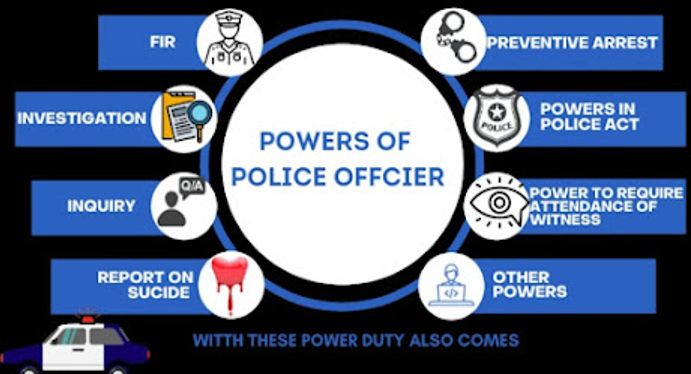
Introduction
The police force in India plays
an essential role in maintaining law and order, preventing crime, and ensuring
national security. However, the extent of police powers has often been the
subject of debate. While law enforcement agencies require strong authority to
perform their duties effectively, absolute power can lead to misuse and human
rights violations.
This article provides a detailed
legal and institutional analysis of police powers in India, examining their
legal framework, judicial oversight, political influences, and the ongoing need
for reforms to ensure accountability.
Historical Evolution of the
Police System in India
Ancient and Medieval Policing
In ancient India, law enforcement
was handled by local village officials like Kotwals and Chowkidars. The Mauryan
and Gupta empires had organized police forces focused on maintaining order and
intelligence gathering.
Colonial Policing: The Indian
Police Act, 1861
The British introduced The
Indian Police Act, 1861, which created a centralized, authoritarian police
system. The primary goal was controlling rebellion rather than serving
citizens, leading to a system based on fear rather than trust.
Post-Independence Developments
After 1947, efforts were made to
democratize the police force, but much of the colonial legacy remains. The need
for police reforms has been highlighted in multiple reports, yet implementation
remains slow.
Legal Framework Governing
Police Powers in India
The Indian Police Act, 1861
The Indian Police Act,
1861 governs the structure and functioning of the police force.
Critics argue it grants excessive powers to police officials with limited
accountability.
Code of Criminal Procedure
(CrPC), 1973
The Code of Criminal
Procedure (CrPC), 1973 defines the procedures for arrest, search, and
investigation. It provides guidelines for bail, detention, and custodial
rights, ensuring that the police operate within specific rules.
Indian Penal Code (IPC), 1860
The Indian Penal Code
(IPC), 1860 specifies offenses related to police misconduct, such as
unlawful detention, custodial torture, and corruption. Sections like 166A and 376(2) penalize
police personnel for misconduct and abuse of authority.
Special Laws Granting
Extraordinary Police Powers
- National Security Act (NSA), 1980: Allows
preventive detention without trial.
- Unlawful Activities (Prevention) Act (UAPA),
1967: Grants extensive powers to combat terrorism, often criticized
for misuse.
New Criminal Laws Reshaping
Police Powers in India
India has introduced significant
reforms in the criminal justice system, most notably the Bharatiya
Nyaya Sanhita (BNS), Bharatiya Nagarik Suraksha Sanhita (BNSS),
and Bharatiya Sakshya Adhiniyam (BSA), which replace the old laws
like the IPC, CrPC, and Indian Evidence Act. These new laws have changed the
nature of police powers and introduced critical measures for public
accountability.
Bharatiya Nyaya Sanhita (BNS),
2023
The BNS (which
replaces the IPC) modernizes the way crimes are classified and prosecuted in
India. This new law empowers police to deal with organized crime, hate
crimes, and terrorism more effectively, ensuring swift responses to
national security threats. However, it includes safeguards to prevent the abuse
of power.
Bharatiya Nagarik Suraksha
Sanhita (BNSS), 2023
The BNSS, which
replaces the CrPC, overhauls procedures around arrests, detentions, and bail.
It ensures that police follow standardized procedures, ensuring citizen
rights are not violated during arrest or interrogation. A key feature
of the BNSS is mandatory video recording of arrests and searches to
protect both the police and the accused.
Bharatiya Sakshya Adhiniyam
(BSA), 2023
The BSA, replacing
the Indian Evidence Act, introduces measures to streamline electronic
evidence, forensic science, and digital documentation in criminal trials.
Police are now bound by the new provisions on admissibility of
electronic evidence, including video footage and digital records, ensuring
transparency in investigations.
Absolute vs. Reasonable Power:
Where is the Line?
Understanding Absolute Power
in Law Enforcement
Absolute power implies
unchecked authority, which can be misused for personal gain or to suppress
rights. In democratic societies like India, police powers should be exercised
with reasonable limits, ensuring they are not used for oppression. Legal
reforms under the BNS, BNSS, and BSA aim to ensure that police
actions are reasonable, transparent, and accountable.
Judicial Oversight as a Check
on Police Powers
Courts play a crucial role in
regulating police conduct. Landmark cases, such as DK Basu v. State of
West Bengal (1997), laid down guidelines to prevent custodial
torture and illegal detention, placing necessary checks on
police power. The introduction of new criminal laws has incorporated some
of these judicial directions to ensure that police powers are aligned with
fundamental rights.
Police Discretion and Use of
Force
Legal Provisions for the Use
of Force
The BNSS, 2023,
outlines specific provisions for the use of force by police when
making arrests. It ensures that force is used only when absolutely necessary,
and excessive force is penalized. Additionally, the Arms
Act, 1959, which continues to regulate the use of firearms by law
enforcement, now works alongside these new provisions to create clearer
guidelines for police engagement in violent or volatile situations.
Cases of Police Excesses and
Brutality
While the introduction of
the new criminal laws has brought about greater accountability
measures, there continue to be concerns regarding fake encounters, custodial
deaths, and police brutality. The 2019 Hyderabad Encounter Case sparked
nationwide debates about police accountability, leading to a
renewed call for reforms.
Judicial Scrutiny and
Accountability Mechanisms
Role of Judicial Oversight
The Supreme Court of India has
played a crucial role in regulating police power. Through rulings in cases such
as Prakash Singh v. Union of India (2006), the court mandated police
reforms to ensure greater accountability and transparency.
The National Human Rights Commission (NHRC) and State
Human Rights Commissions (SHRCs) provide additional mechanisms
for investigating allegations of police misconduct and
protecting citizens' rights.
Challenges Faced by Police in
India
Lack of Independence from
Political Influence
One of the primary challenges
facing police forces in India is political interference. Police are
often perceived as tools of political power, compromising their ability to act
independently. This has been a significant barrier to ensuring accountability and
the effective use of police powers.
Inadequate Training and
Manpower Shortages
Police forces in India face severe
resource shortages, including a lack of proper training and inadequate
infrastructure. The new criminal laws aim to address these
concerns by introducing specialized training programs and
improving technological infrastructure.
Poor Public Trust and
Perception
The perception of police
brutality and corruption has hindered public trust in the police
system. The introduction of new laws aims to increase transparency and reduce
abuse by holding officers accountable for their actions.
Future of Policing in India:
Way Forward
To ensure effective policing
while upholding citizens' rights, the following steps are essential:
- Implementing police reforms to reduce
political interference and ensure independence.
- Promoting community-based policing to
build stronger relationships between the police and the public.
- Strengthening judicial oversight to
ensure proper checks on police powers and avoid misuse.
- Utilizing technology to enhance the
efficiency and transparency of police investigations.
Conclusion
The police force in India plays a
vital role in ensuring law enforcement and national security. However, without
proper accountability, absolute power can lead to misuse and human rights
violations. By strengthening police oversight, implementing reforms,
and promoting ethical policing, India can create a more just
and transparent law enforcement system.
FAQs
1. What is the main law
governing police in India?
The primary law governing police
forces in India is The Indian Police Act, 1861. However, the new
criminal laws (BNS, BNSS, BSA) have modernized the approach to
policing.
2. Can police arrest without a
warrant?
Yes, under Section 41 of
the CrPC, police can arrest without a warrant in cognizable offenses.
3. What are the key police
reforms suggested in India?
Reforms suggest reducing political
influence, ensuring accountability, and modernizing police
training to adapt to contemporary challenges.
4. What is the role of NHRC in
monitoring police?
The National Human Rights
Commission (NHRC) investigates allegations of human rights
violations by the police and ensures accountability.
5. What legal protections
exist against police abuse?
Article 21 (Right to
Life), NHRC, and Supreme Court rulings provide legal
protections against police excesses and guarantee fundamental rights.